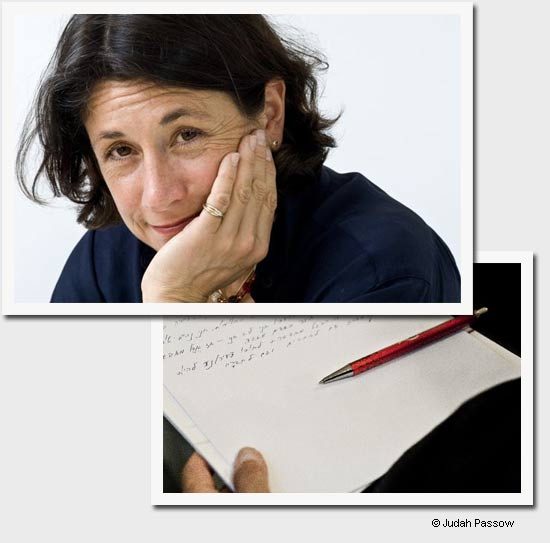
Alexandra Senfft is a German Author

Featured

“Every democracy must be stimulated, challenged and developed – continuously. Democracy lives and thrives through self-critical confrontation with the past – personal and collective – and by scrutinizing the assumptions of earlier generations. Where such reflection does not take place, people adhere rigidly to generationally-transmitted patterns of thinking, feeling and action. Lack of reflection allows far-right and nationalistic forces present outmoded messages of salvation that develop their own dynamics and create new injustice.
By means of dialogue my work, in an interdisciplinary and international fashion, confronts the past to develop tasks for the present so that society can withstand anti-democratic, antisemitic and racist trends and movements in the future.”
Alexandra Senfft
 

Alexandra’s central themes

  • Biographical work, life portraits, political analysis
  • Intergenerational consequences of the Holocaust, especially for perpetrators’ descendants
  • Dialogue between descendants of Holocaust survivors and of Nazi victimizers
  • Storytelling and dialogue in intractable conflicts based on the resolution approach of Israeli psychologist Dan Bar-On
  • Israel and Palestine: the conflict and the Peace Movement
  • Germans vis-a-vis Israelis and Palestinians in the Middle East Conflict
  • Anti-Semitism, populist hostility to Muslims, anti-Roma racism

Senfft presents and discusses her areas of expertise in Germany and abroad. She lectures, participates in round tables and panels, speaks on radio and TV,  features in film documentaries. Outside of Germany, Senfft has presented her work for example at the University College London (UCL), the Leo Baeck College (London), Facultad de Ciencias Sociales (University of Buenos Aires), Ben Gurion University (Israel), Harvard University (Boston), Brandeis University (Newton, MA), Queens University (Charlotte, North Carolina), in synagogues in Birmingham (Alabama), Savannah and Augusta (Georgia), in Austen Riggs Center (Stockbridge, USA), Goethe Institute, Bratislava (Slovakia) or Heinrich Heine Haus (Paris).

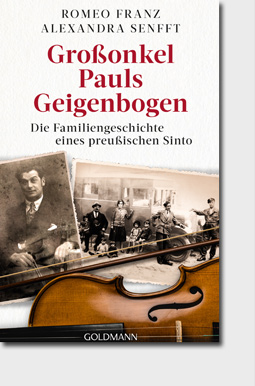
In March, 2024 she published “Greatuncle Paul’s violin bow. The family history of a Prussian Sinto” with her co-author Romeo Franz.

Her book, Silence Hurts: A German Family History («Schweigen tut weh. Eine deutsche Familiengeschichte», Ullstein Buchverlage, Berlin 2007) won the German ‘Best Biography Award’ [2008]. The book was translated into Slovakian and published in Bratislava in September 2018.

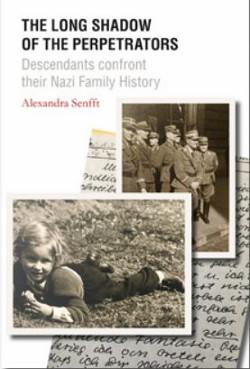
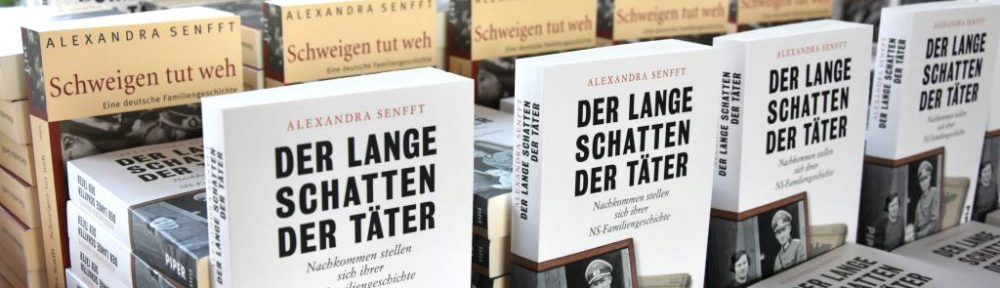
Alexandra’s book Strange Enemy, so far. Encounters with Palestinians and Israelis («Fremder Feind, so nah. Begegnungen mit Palästinensern und Israelis») was released in 2009, and in 2016 she published The Long Shadow of the Perpetrators. Descendants face their Nazi family history («Der Lange Schatten der Täter. Nachkommen stellen sich ihrer NS-Familiengeschichte»).

She is deputy chair of the Study Group on Intergenerational Consequences of the Holocaust, PAKH, on the board of the Lagergemeinschaft Dachau, a member of PEN Berlin, Pro Asyl and Reporters without Borders
History that hurts

Academics confronting their family histories: methodological and ethical inquiries
Zeitgeschichte online, August 7th, 2026
>> go to essay

[…] The theme of being ‘implicated subjects’ (Michael Rothberg[iv]) with strong attachments to our families’ histories, was, at the end of the workshop again picked up by Alexandra Senfft, who — as the author of an acclaimed family history revolving around her grandfather who had been a high-ranking Nazi official — commented on all presentations. She pointed out that we are all products of our families’ histories: we have grown up with conspicuous silences and taboos as well as lies and stories that we are supposed to believe. We are also faced with conflicting double-bind messages, where one thing is said and the non-verbal communication brings across something else. All participants indeed talked about their forefathers’ involvement in the Nazi project having had sustained repercussions for family life and relationships during and long after the war. All grew up with troubled family histories which had a lasting effect on the next generations. That is why we may be bent on breaking the silence, how hurtful and distressing this may be for us. Senfft indeed suggested that we may be driven to explore these suppressed histories because they have been ‘passed on’ or ‘delegated’ to us as a kind of ‘silent or unspoken assignment’. These realities that we uncover may trigger unpleasant feelings and force us to realize that history hurts…

After listening attentively to the stories that had unfolded during the day, Alexandra Senfft commented on all the presentations, sharing her observations and theoretical considerations. She is the author of the highly acclaimed family history Schweigen tut wehEine deutsche Familiengeschichte (2007) as well as Der lange Schatten der Täter: Nachkommen stellen sich ihrer NS-Familiengeschichte (2016).[v]In addition, she collaborated with Dan Bar-On, an Israeli psychologist and therapist who initiated and facilitated German-Israeli and Israeli-Palestinian dialogues, encouraging people to share their painful stories and listen to others.[vi] Dialogue in conflict is understood as part of a process of understanding and rapprochement in the spirit of active peace work. Working with him, Alexandra gained much experience in terms of listening to the stories of victims and perpetrators alike. She explained that the transition from monologue to dialogue offers opportunities to move ahead: from solely confronting one’s own history to listening and empathizing with others, sharing and exchanging one’s thoughts and thereby giving them another quality.”

Forever Grateful

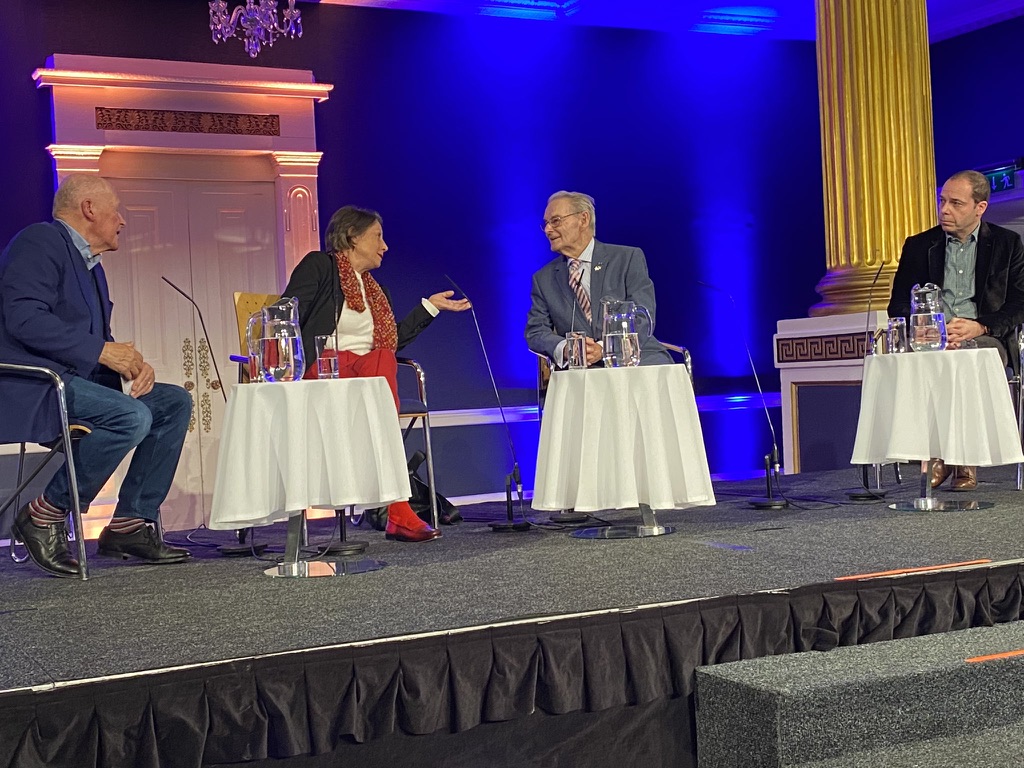
The granddaughter of a prominent Nazi has said she will be “forever grateful” for the opportunity to meet and discuss the past with Irish Holocaust survivor Tomi Reichental. 

Alexandra Senfft on Newstalk, Claire Byrne Show, Ireland, 4 June 2026

>> listen to Interview on Claire Byrne Show, June 4th, 2026

My Nazi grandfather sent Tomi Reichental to Bergen-Belsen death camp 

Despite all the suffering he endured, the Holocaust survivor chose compassion over hate
Irish Times, June 2, 2026

I was deeply anxious during the train journey from Vienna to Bratislava, the Slovak capital, in 2014. Holocaust survivor Tomi Reichental was expecting me there, together with Gerry Gregg’s film crew. They were shooting the documentary Close to Evil. 

Tomi was born in Czechoslovakia but moved to Ireland in 1959. He had been a young boy when he and his family were deported by the Nazis to the Bergen-Belsen concentration camp in Germany in 1944. Tomi survived, but 35 of his relatives were murdered in the Holocaust; his grandmother died before his eyes in the camp.

My grandfather, however, was Hanns E Ludin, the “envoy of the Third Reich to Slovakia”, and it was he who signed the deportation orders. Ludin was convicted as a war criminal and executed in Bratislava in 1947.

Tomi’s and my family histories were thus tragically intertwined….

>> continue reading Irish Times, 2 June, 2026

Dialogue, Memory, and Conflict Across Germany and the Middle East

Join us for a conversation with Alexandra Senfft, who draws on personal storytelling and biographical reflection to explore the human dimensions of the Middle East conflict.

SOAS ICOP

SOAS University of London (MB G3)London, England

Friday, Feb 20 from 5 pm to 7 pm GMT

>> link to the event

New Book – Großonkel Pauls Geigenbogen/Great uncle Paul’s violin bow

The family history of a Prussian Sinto
Alexandra Senfft
Romeo Franz

ca. 304 Seiten
Hardcover mit Schutzumschlag
inkl. Abbildungen
24,- € [D] │24,70 € [A] │CHF 32,90
ISBN: 978-3-442-31707-3
March 2024
Randomhouse/Penguin
>> see announcement

Romeo Franz is the first Romani person (Sinto) in the European Parliament. In Great-Uncle Paul’s Violin Bow, Alexandra Senfft tells the story of his family from the end of the 19th century through the Nazi era up to the present day. 

Characterised by the love of music, great solidarity in the family and resilience, the book is a gripping historical chronicle of the Romani people. With great narrative power this book informs about the resistance, self-determination and success of the Franz family. It is an impressive plea against discrimination and racism.


My Talk at Brandeis University, Newton (MA)

October, 15th, 2024

Mare Manuschenge. Sinti and Roma: A century between persecution, resistance and self-empowerment

Romani people have been discriminated against and persecuted ever since their first documented appearance in Europe in the 15th century. Their victimization culminated in the Nazi genocide: Hundreds of thousands of European Sinti and Roma were disenfranchised, detained, tortured, sterilized and murdered. After 1945, the survivors were hardly compensated for their suffering or their human and material losses. Instead, they were again criminalized and are marginalized to this day. Only in 1982 did the German government officially recognize the genocide and its responsibility for the persecution of the largest minority in Europe. Still, Sinti and Roma are treated as second class victims in the commemoration of the Nazi crimes. In spite of the fact that they are a recognized minority in Germany, they are confronted with anti-Romani racism which is deeply engrained in the society, mostly passed on by intergenerational transmissions that are rarely reflected upon.

In her talk, Alexandra Senfft speaks about the persecution and discrimination of the Sinti and Roma, but also highlights their resistance and resilience as well as their self-empowerment. Her material is based on the family history of the German Sinto Romeo Franz. Franz, who identifies as a Prussian Sinto, is a well know musician of Sinti-jazz and was the only German Sinto ever voted into the European parliament. With his music and is civil rights activism, he continues family traditions of culture and resistance which can traced back to Berlin at the beginning of the 20th century.

>> stream event

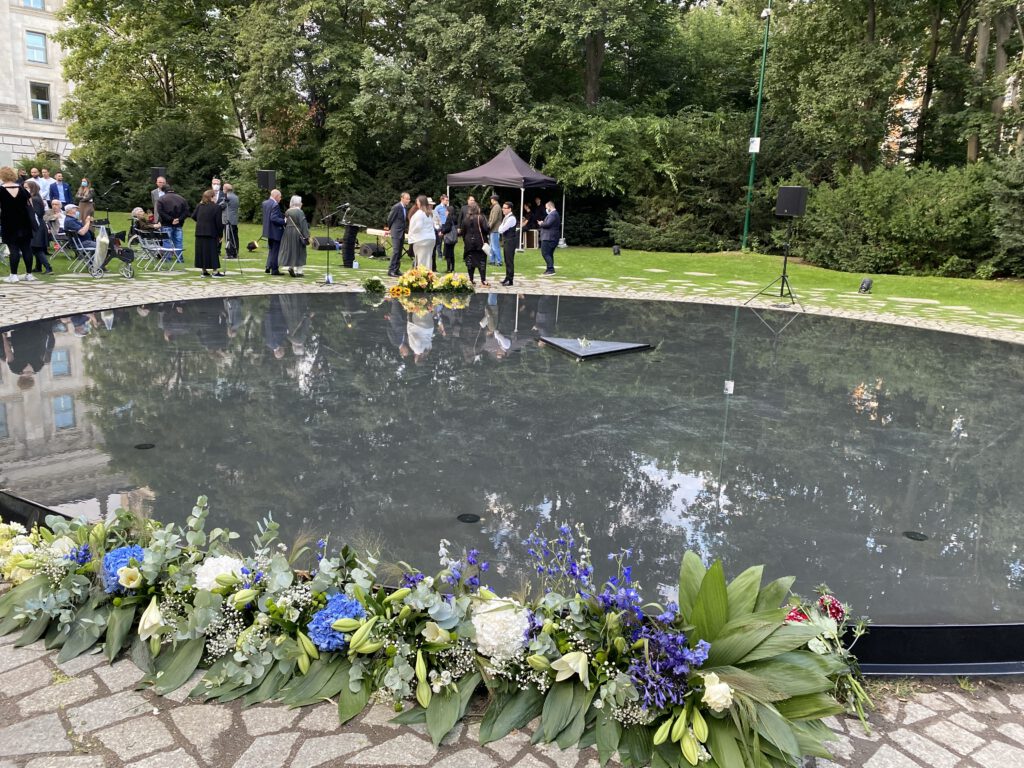
Plan to remove Sinti-Roma memorial causes outrage

A new train tunnel running under the memorial has been described as ‘macabre’ given how many Sinti and Roma were deported by rail to their deaths
Derek Scally in Berlin
Fri Aug 02 2024

“This is a symbolic grave for all those who lost their lives, and it is a shame if it is up to this minority to defend it,” said Alexandra Senfft, co-author of Great Uncle Paul’s Violin Bow, a memoir about Romeo Franz and his family. “This is also a memorial for the German people and it is our responsibility, as the majority in the society, to save it.”

>> to article, Irish Times 2/24

Foto: Alexandra Senfft

Sinti

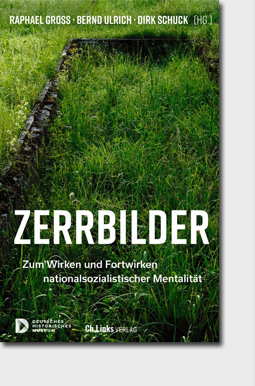
Verlust, Verleugnung, Verschweigen in Zerrbilder

Verlust, Verleugnung, Verschweigen
Reflexionen über die Mechanismen familiärer Erinnerungen – ein Prozess
Alexandra Senfft
in: Gross, Ulrich, Schuck (Hg.) Zerrbilder. Zum Wirken und Fortwirken nationalsozialistischer Mentalität
April 2024

Ch. Links, Aufbau Verlage, Berlin 2024

https://www.aufbau-verlage.de/ch-links-verlag/zerrbilder/978-3-96289-211-1